Pellieux’s Investigation of Picquart
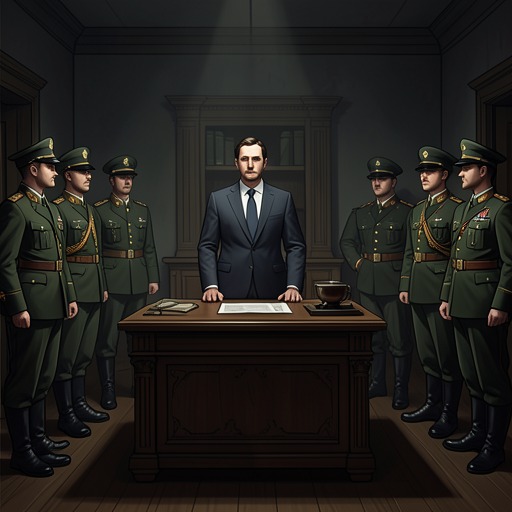
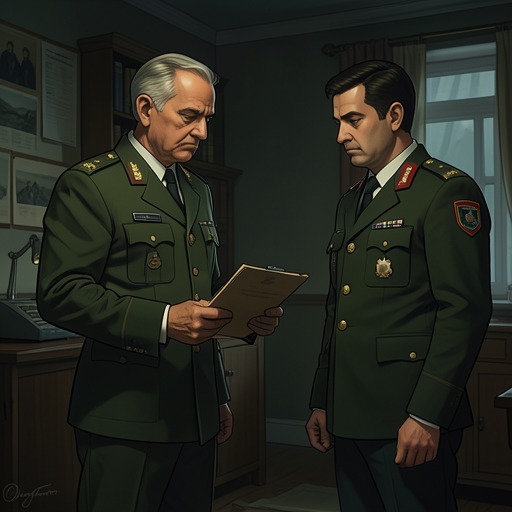
An Officer and a SpyPellieux’s Investigation of Picquart turns a military inquiry into a test of what the institution is willing to investigate. Georges de Pellieux was ostensibly to establish the facts of Georges Picquart’s inquiry into Major Esterhazy and advise the minister whether discipline was warranted. Yet as Pellieux pressed Picquart over dates, a damaged telegram, and private associations, he excluded the central questions Picquart wanted answered: who wrote the bordereau and whether forged material had helped convict Alfred Dreyfus. Picquart’s eventual withdrawal exposed the inquiry’s governing contradiction: it scrutinized the investigator while placing the substance of his findings outside its scope.
Background and Institutional Pressure
The inquiry followed Picquart’s effort to persuade his superiors that the case against Dreyfus could not be sustained and that Esterhazy merited investigation. At a meeting with Charles-Arthur Gonse, Picquart laid out the petit bleu, surveillance photographs, and secret file. He said that he had hoped to find proof of Dreyfus’s guilt in the dossier but found nothing that could withstand even ten minutes of competent cross-examination. Gonse methodically examined the documents, but his response was to tell Picquart to forget the bordereau: Esterhazy could be investigated, he said, so long as the investigation was not connected to it.
Gonse later acknowledged that the original investigation of Dreyfus had not been handled professionally. He attributed this in part to Jean Sandherr’s illness and to the conduct of Armand du Paty de Clam, but argued that reopening the case would expose old wounds and risk tearing the country apart. His appeal for Picquart to help shut the matter down culminated in a formal order: Picquart was not to investigate anything connected with Dreyfus or disclose information to anyone unauthorized. Gonse invoked the chain of command, from the minister to the chief of staff, himself, and then Picquart. The inquiry therefore began in an atmosphere where Picquart’s superior had already treated investigation itself as a threat.
Secrecy was also part of the case’s established machinery. At Dreyfus’s court-martial, prosecutor Brisset had requested a private hearing on the grounds that the evidence concerned national defence, while defence counsel Edgar Demange objected that Dreyfus had a right to the same treatment as any accused person. Later, when the press first reported the secret file, Picquart counted the people who had access to it: nineteen, before adding Mathieu Dreyfus as the twentieth. He understood that information could travel through officers, judges, officials, and families, and feared that public exposure would make Gonse and Raoul le Mouton de Boisdeffre more determined to restrict his inquiry rather than reconsider the case.
The Inquiry and the Petit Bleu
Pellieux told Picquart that the inquiry was intended to establish the facts concerning his investigation of Esterhazy. He had already interviewed Esterhazy, Mathieu Dreyfus, Auguste Scheurer-Kestner, and Louis Leblois, and would recommend to the minister whether disciplinary action was appropriate. The formal purpose sounded procedural, but its questioning quickly concentrated on details that could discredit Picquart.
One pressure point was the date on which Picquart had first received material concerning Esterhazy. Pellieux confronted him with Major Henry’s recollection: Henry had been on compassionate leave beside his dying mother, returned briefly to Paris in early March, met an agent, received documents, and passed them to Picquart. Picquart had reported a later date. He had been investigating Esterhazy for nearly six months without Gonse’s knowledge and had altered the date in his report to make the period appear closer to four months. He had thought the adjustment would make his unauthorized work easier to accept; under Pellieux’s hostile questioning, it became an apparent sign of suspicion.
Pellieux also suggested that Picquart could have tampered with the petit bleu after receiving it from Henry and before passing it to Captain Lauth, even though Picquart said it had been locked away. The telegram card was presented as evidence against him. Pellieux cited microscopic examination showing that the original address had been scratched out and Esterhazy’s written over it, and chemical analysis distinguishing the ink on the back from the ink on the front: one was iron gall ink, while the other contained an ingredient found in Campeche trees. Picquart was surprised by the findings and said the document must have been tampered with after he left Paris; he insisted it had been genuine when he handled it in the section. Pellieux refused his request to inspect it more closely, declared it a fake, and suggested that Picquart was the likely forger. He further challenged Picquart over having asked Lauth for help making the petit bleu look more genuine.
The questioning thus converted a potentially compromising document into an accusation against the man who had used it to pursue Esterhazy. The inquiry did not establish in these exchanges that Picquart had forged the card; instead, Pellieux put forward the card’s altered state and Picquart’s conduct as grounds for suspicion. The distinction mattered: Picquart’s account was that the document had been genuine when in his possession and had been altered later, while the inquiry treated him as a plausible perpetrator without allowing him to examine the card himself.
Private Allegations and the Limits of the Inquiry
The interrogation extended beyond official documents. On the following morning Pellieux resumed questioning about Picquart’s possession of the petit bleu, then asked what he had disclosed to Pauline Monnier, the wife of Philippe Monnier of the Foreign Ministry. Picquart immediately insisted that she had nothing to do with the case. Pellieux responded that the inquiry would decide whether the relationship mattered, including whether she was the veiled woman said to have contacted Esterhazy or whether Picquart had exposed himself to blackmail.
Pellieux also revealed that Picquart’s apartment had been searched while Picquart was at sea. He said he had authorized the search at Henry’s request, after Esterhazy alleged that a veiled woman had told him Picquart was keeping secret papers at home. Picquart said he had not known of the raid and would have protested. The private allegation and search widened the inquiry’s reach into Picquart’s personal life while leaving the central evidence unresolved.
Picquart tried to force that distinction into the open. He asked whether he would be questioned about the main facts of the case: that Esterhazy had plainly written the bordereau, whose handwriting the government’s principal expert conceded was a perfect match, and that falsified material had been used in the dossier that convicted Dreyfus. Pellieux ruled both matters outside the inquiry’s scope. Picquart also raised the alleged conspiracy within the General Staff to keep him in North Africa, or even send him to his death, to prevent him exposing what had happened. Pellieux again declared the subject outside the inquiry.
Withdrawal and Public Consequences
After Pellieux excluded these questions, Picquart declared the inquiry a sham, said its conclusions had been written before he began giving evidence, and withdrew his cooperation. He stood, saluted, and left the room with his suitcase. Reporters who had not noticed his departure at first recognized him as he hurried into the street and chased after him; he ignored their questions, pushed past men who tried to block him, and escaped in a taxi on the rue de Rivoli. His departure made visible the break between the inquiry’s official procedure and the questions it refused to address.
The dispute had already escaped the military chain of command. An anonymous article in L’Éclair had publicly alleged that Dreyfus’s guilt was proved by a secret file passed to the court-martial judges, prompting Picquart to count those with access to the dossier. Esterhazy then used an interview in Le Matin to blame Picquart, alleging that the colonel was a friend of the Dreyfus family, had opened an investigation to destroy him, and had shown secret files to Leblois. Picquart’s name, previously associated with work in the shadows, was now printed in a newspaper as the alleged source of the scandal.
After leaving Pellieux’s inquiry, Picquart met a group of Dreyfusards at Georges Charpentier’s house, where Georges Clemenceau began applauding and Mathieu Dreyfus greeted him with praise. Émile Zola, Joseph Reinach, Arthur Ranc, and others were also present. Picquart warned that the meeting could be discovered and said he needed to speak and leave. The scene marks a shift from a concealed investigation within the army toward direct contact with public advocates of reopening the case.
At Zola’s trial, Pellieux’s intervention brought the inquiry’s contradiction into the courtroom. After the defence read a passage from the indictment that was supposed to remain behind closed doors, Pellieux claimed that in November 1896 absolute proof of Dreyfus’s guilt had reached the Ministry of War. He described a document said to contain a warning not to acknowledge relations with a Jew and appealed to Raoul le Mouton de Boisdeffre to support his testimony. Picquart recognized the reference as the letter supposedly recovered from the German Embassy, which Jean-Baptiste Billot had read aloud but refused to show him. Pellieux had insisted that his side had kept within legal bounds and did not wish to discuss the Dreyfus case, yet he introduced the secret proof himself. Charles-Arthur Gonse hurried to seek the floor, recognizing the danger of the disclosure. The inquiry’s attempt to contain the case had become another occasion on which its secrecy and its public claims collided.